

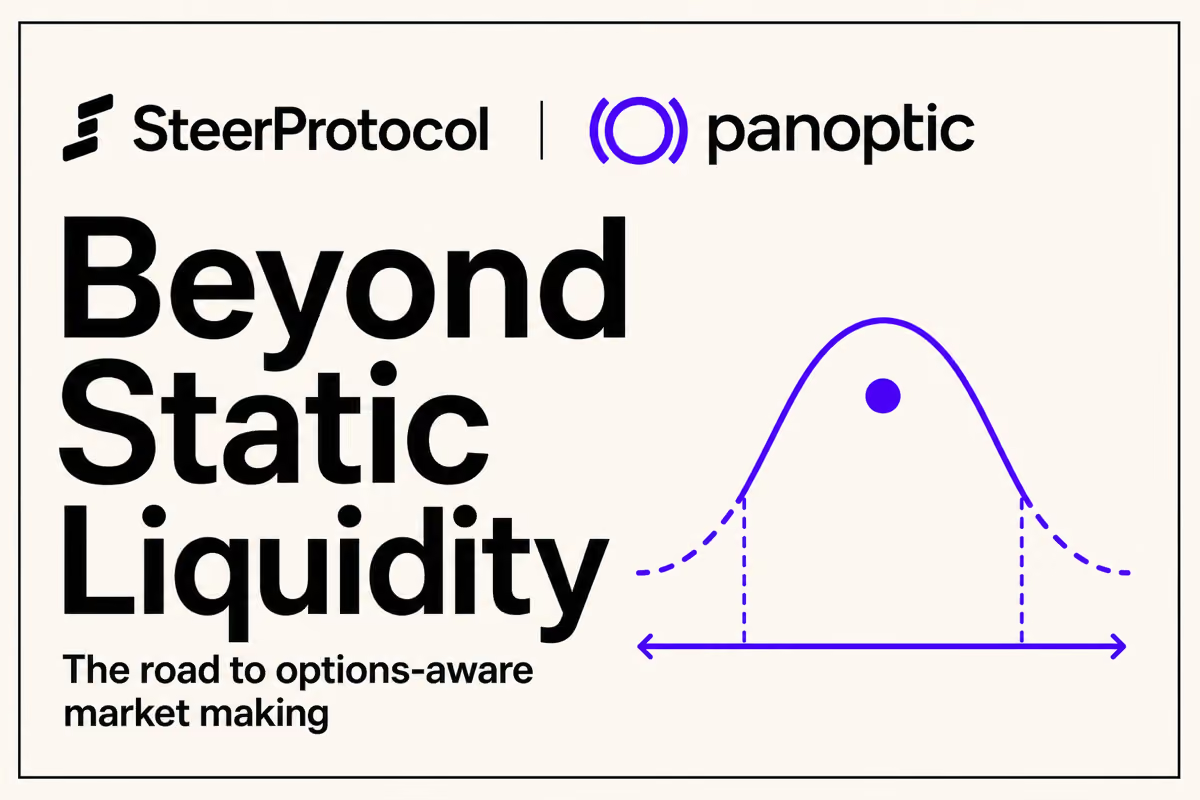
Beyond Static Liquidity: The Road to Options-Aware Market Making
Steer and Panoptic explore automated liquidity strategies that manage ranges, inventory, volatility, and hedging as one coordinated system.

Automated LP strategies made concentrated liquidity easier to manage. The next step is to manage liquidity, inventory, and volatility as one system.
Concentrated liquidity changed decentralized market making. Instead of spreading capital across every possible price, liquidity providers can place it where trading is most likely to occur. That makes capital more efficient—but it also turns a passive LP position into an active strategy.
A range must be selected. Inventory changes as the market moves. Positions can fall out of range. Rebalancing can keep capital active, but every adjustment introduces a new decision about timing, exposure, and cost.
Automated liquidity managers solved an important part of this problem by making range management programmable. The next frontier is broader: moving beyond strategies that only react to spot price and toward market making that also understands volatility and options exposure.
That is the research direction Steer and Panoptic are exploring together.
Range Management Is Not the Same as Risk Management
Every concentrated-liquidity position expresses a market view, even when the LP does not describe it that way. Range width, placement, and inventory determine how the position behaves as price moves. A narrow range may concentrate fee generation, but it also changes the position more quickly and can become inactive sooner. A wider range behaves differently again.
Automation can recenter that range, yet simply staying active does not answer the full set of questions a market maker faces:
- How much directional exposure has accumulated?
- Is current volatility compensating the strategy for the risk it is taking?
- When is rebalancing preferable to hedging?
- How do trading fees compare with inventory loss, hedge costs, borrowing costs, and execution slippage?
- How should the strategy behave when market conditions change sharply?
An options-aware strategy brings those questions into the same decision loop as liquidity placement. The objective is no longer just to keep capital in range. It is to manage inventory, volatility, and execution as parts of one portfolio.
Why Panoptic Changes the Design Space
Panoptic makes the relationship between AMM liquidity and options explicit and programmable. Its protocol supports perpetual options, lending, portfolio-aware margin, and market-making infrastructure onchain.
That model is already visible in Panoptic V2, which launched on Ethereum in June 2026. Panoptic’s own Vault Suite includes a USDC strategy that combines lending with automated gamma scalping and a WETH strategy that combines lending, systematic options market making, and automated delta hedging.
These vaults illustrate an important shift. Market making does not have to be treated as an isolated LP position. It can be structured as a system that coordinates capital, options exposure, hedging, and execution under a defined policy.
Panoptic provides the volatility and options layer for that system. It makes it possible to express and manage risks that remain implicit in a conventional LP position.
Where Steer Fits
Steer provides the strategy automation and operational layer.
Steer Smart Pools already automate concentrated-liquidity placement and rebalancing across partner DEXs. More flexible frameworks such as Dynamic Rebalance allow a strategy to control placement, range width, liquidity shape, and rebalance triggers while incorporating market data beyond the local pool.
The natural next step is to make those decisions options-aware.
Instead of responding only to spot price or whether a range is active, a managed strategy could evaluate a broader state: current inventory, realized and implied volatility, delta and gamma exposure, options demand, available liquidity, and the cost of rebalancing or hedging. It could then decide how much capital to deploy, where to place it, when to reshape it, and when an options position or hedge is the better tool.
This is the complementary fit between the two protocols:
- Panoptic provides the options, volatility, lending, and market-making rails.
- Steer provides programmable strategy execution, managed-vault operations, product structuring, and partner distribution.
Together, those layers create a path from automated range management to automated portfolio management.
What Options-Aware Market Making Can Unlock
For LPs, options-aware automation can create strategies that target a more deliberate balance between fee income, inventory exposure, and volatility risk. Rather than treating impermanent loss or directional inventory as an after-the-fact result, a strategy can include those exposures in its operating rules.
For protocols and treasuries, it can support managed liquidity programs with explicit risk objectives. A treasury may want to keep a core asset position while providing liquidity, hedge part of its downside, or adjust its market-making posture as volatility changes.
For asset issuers and reference-priced markets, the same framework can eventually support liquidity that follows both fair value and volatility. Spot liquidity can be shaped around a benchmark while options provide additional tools for hedging, risk transfer, and structured participation.
These are design opportunities, not promises of a single universal strategy. A model that works in a quiet ETH market may fail in a sharp trend. A strategy that appears attractive before costs may look very different after slippage, hedging, borrowing, and gas. Capacity also matters: results at small scale do not automatically survive larger deployment.
That is why the work should be evaluated across multiple market regimes with transparent accounting for total portfolio performance—not only fee APR. The real research question is whether combining automated liquidity placement with explicit options and hedge management produces more durable outcomes after every source of risk and cost is included.
What Comes Next
Static liquidity was the starting point. Concentrated liquidity made markets more capital efficient. Automated LP strategies made those positions easier to operate.
Options-aware market making is the next step: treating liquidity, inventory, volatility, and hedging as one coordinated system.
Panoptic has built the onchain volatility infrastructure. Steer is building the strategy and vault layer that can turn those primitives into managed products and repeatable partner deployments. Our next phase is to test how these systems work together, make the risk model legible, and bring the first Steer-built Panoptic vaults to market.
Explore Panoptic V2 and follow Steer and Panoptic for updates as this work moves from research into live strategies.
This article is for informational and educational purposes only. Liquidity provision and options strategies involve risk, including possible loss of principal.
Recent Insights and Updates
Expand your knowledge with these hand-picked articles, tailored to keep you ahead in the space.

.avif)