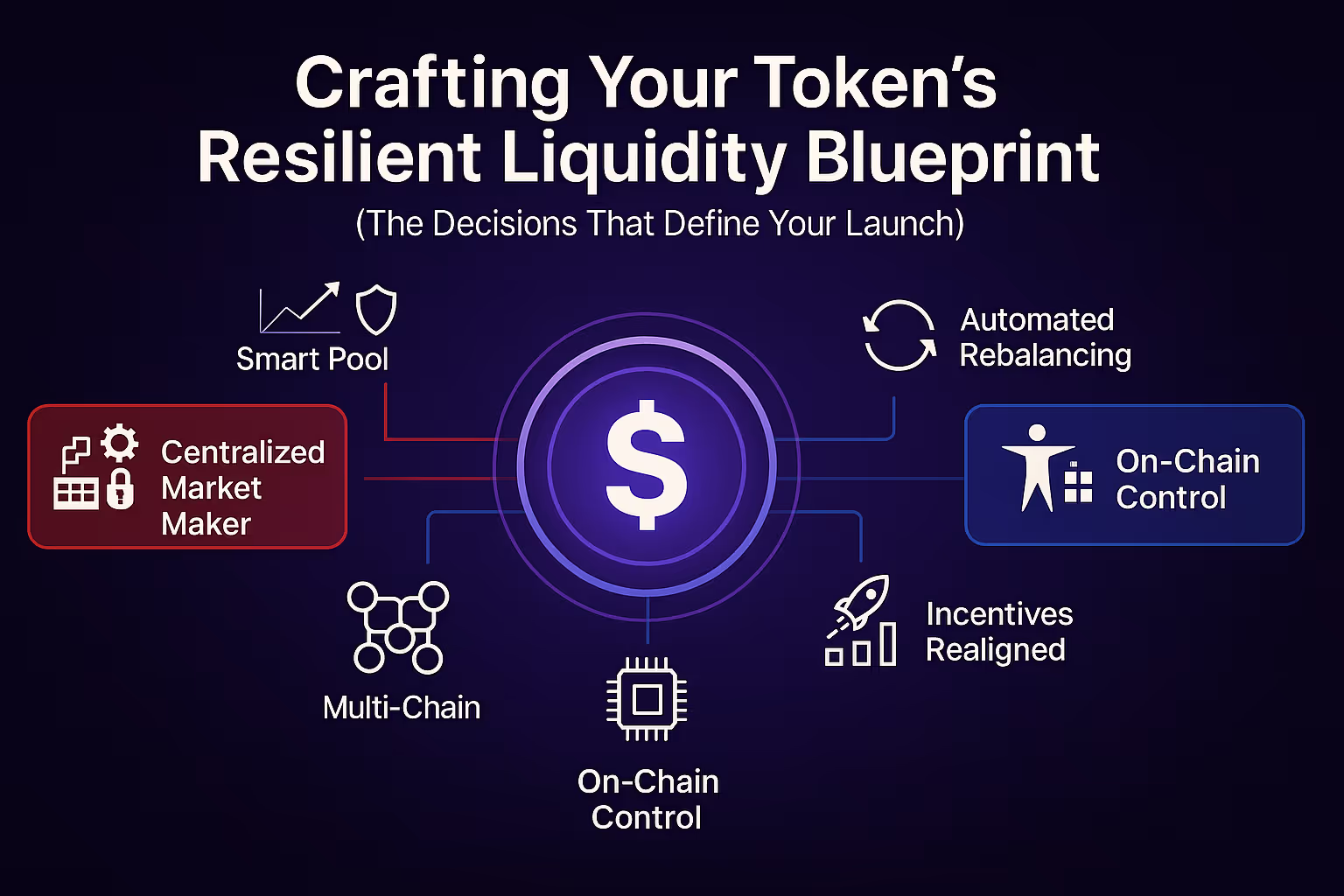
Crafting Your Token's Resilient Liquidity Blueprint (The Decisions That Define Your Launch)
The Unseen Crucible: Your Pre-TGE Liquidity Strategy

The buzz is building. Your community is eager. Your tokenomics are finalized. But before your Token Generation Event (TGE) officially ignites, a crucial, often under-estimated battle is waged: designing how your liquidity will behave under stress. This isn’t a minor technical detail, it’s the foundation for your token’s first impression: market stability, price discovery, slippage, and credibility.
Most teams default to a familiar answer: “the market maker will handle it.” And sometimes that’s the right move, especially if your launch is CEX-led. But it also comes with real trade-offs: counterparty dependence, limited transparency, and fewer enforceable on-chain levers when things get chaotic. If you want launch-day stability without becoming primarily dependent on a centralized operator, you need an on-chain liquidity plan that’s programmable, transparent, and responsive.
Many asset issuers also assume that “more capital = better liquidity.” In the era of concentrated liquidity AMMs (CLMMs) like Uniswap V3-style pools, the reality is more nuanced: where capital sits matters more than how much exists. Passive ranges get pushed out, liquidity goes one-sided, and your treasury can become inert at the exact moment it’s supposed to support the market.
Without a proactive, intelligently designed Automated Liquidity Management (ALM) plan before your TGE, you risk:
- Extreme volatility and high slippage on launch day
- Rapid depletion or misallocation of valuable treasury capital
- Frustration among early investors and LPs from poor execution
- A damaged perception of your token’s market integrity
This article walks through the critical pre-TGE decisions you must make, including the centralized-MM vs on-chain-control choice, and shows how Steer Protocol helps you build a resilient liquidity blueprint from day one.
1. Centralized Market Maker vs On-Chain Control
On token launch day, most teams face a practical decision: do we mainly rely on a centralized market maker (MM), or do we build launch liquidity that’s primarily governed on-chain? There isn’t a universal right answer but there are clear trade-offs, and most teams only hear one side of the story.
Why teams hire a centralized market maker (the real benefits)
A good MM can be genuinely valuable, especially if your plan is CEX-led from day one:
- CEX readiness & operational coverage: 24/7 quoting, inventory management, and tight execution loops during volatile hours.
- Tighter displayed spreads (in ideal conditions): A professional desk can dampen micro-volatility when the market is thin.
- Launch coordination: Some MMs help align liquidity, listings, and initial market narrative across venues.
The trade-offs teams should understand (before committing)
The same setup can introduce risks that teams often underestimate:
- Counterparty + opacity risk: Your market stability becomes dependent on one operator’s decisions, systems, and incentives often with limited transparency.
- Incentive misalignment: An MM’s mandate may be “profit + spread capture + inventory protection,” which can diverge from the issuer’s mandate of “healthy price discovery + community fairness.”
- Control risk on day one: If your primary support mechanism is off-chain, your team can’t reliably enforce guardrails (how liquidity is used, when it’s pulled, and why).
- Single-point dependence: If the MM pauses quoting, reduces risk, or reprices aggressively during shock events, the market can gap fast and the team has few levers in real time.
The Steer perspective: reduce dependence, increase control
Steer isn’t “anti market maker.” We’re anti single-point-of-failure market structure.
Our goal is to give issuers a credible alternative (or a strong complement) by making launch liquidity:
- programmable (rules-driven),
- transparent (visible on-chain),
- responsive (automated rebalancing),
- and consistent across chains (parity + reduced fragmentation).
If a team wants to avoid being primarily MM-centric, this is where the rest of the article becomes the playbook: a launch-day command center that keeps liquidity active, in-range, and governed by your strategy not just someone else’s discretion.
2. The DEX Dilemma: Why V3 is Non-Negotiable (and How to Tame Its Complexity)
The first, and arguably most important, decision revolves around your choice of Decentralized Exchange (DEX).
- The Legacy of V2: Simple, yes, but economically archaic. V2 pools spread liquidity uniformly across all possible price ranges. This means 90%+ of your deposited capital sits dormant, earning nothing, and providing negligible depth where trading actually occurs. For an asset issuer, deploying valuable treasury capital into a V2 pool is akin to building a state-of-the-art skyscraper on quicksand – it's inefficient and ultimately unstable.
- The V3 Imperative: Uniswap V3 (and its forks) or Algebra Based AMM introduced concentrated liquidity, allowing you to deploy capital within specific price ranges. This dramatically boosts capital efficiency, meaning you can achieve the same market depth with a fraction of the capital. For a TGE, this translates to deeper liquidity, lower slippage for traders, and potentially higher fee generation for LPs.
- The V3 Trap: The challenge? If the price moves outside your chosen range, your liquidity becomes 100% inactive or be one sided. Manual management is a full-time, resource-intensive job, prone to human error and significant impermanent loss (IL). Most project teams simply don't have the specialized quant talent or the 24/7 operational capacity required.
- Steer's Solution: This is precisely why Active Liquidity Management (ALM) becomes crucial at the planning stage. Steer Protocol allows you to leverage V3's efficiency without its operational burden. We help you select the optimal V3 DEX(s) for your token and then deploy Smart Pools – intelligently managed vaults that handle the complex range adjustments, rebalancing, and fee compounding automatically. You gain the benefits of V3 without dedicating a team to its continuous oversight.
3. Architecting Market Resilience: Pair Selection & Multi-Chain Strategy
Your liquidity isn't just about where it is, but what it is and how broadly it's distributed.
- Avoiding Single-Pool Fragility: Launching with just one trading pair (e.g., TOKEN/USDT) creates a single point of failure. A large sell-off or withdrawal in that sole pool can send shockwaves through your token's entire market, leading to extreme volatility and difficulty for new buyers.
- The Multi-Market Advantage: A robust strategy often involves deploying liquidity across several pairs (e.g., TOKEN/USDT AND TOKEN/ETH). This diversifies risk, encourages organic arbitrage opportunities that create volume, and provides alternative entry/exit points for traders.
- The Multi-Chain Mandate: Today's DeFi landscape is inherently multi-chain. If your token plans to exist on Arbitrum, Base, Optimism, or beyond, planning for consistent liquidity across all these chains before TGE is vital. Price discrepancies between chains due to fragmented or unmanaged liquidity can damage user trust and create exploitable inefficiencies.
- Steer's Solution: We work with SEC registered RIAs to advice on sensible pair selections that align with your tokenomics and ecosystem. Crucially, Steer's infrastructure empowers you to deploy and actively manage consistent liquidity strategies across multiple chains simultaneously. This ensures market parity, prevents price fragmentation, and delivers a unified, healthy trading experience wherever your token resides.
4. Strategic Treasury Deployment: Your POL as a Proactive Asset, Not a Passive Account
Your project's own Protocol Owned Liquidity (POL) is your first and most critical line of defense. Its deployment must be deliberate.
- Beyond "Seeding the Pool": Your POL isn't just an initial deposit; it's a dynamic tool for market maintenance. Pre-TGE, you must decide its objectives: Will it prioritize price stability? Act as a deep liquidity backstop? Or focus on efficient price discovery?
- Protecting Your Treasury's Value: The goal isn't to expose your treasury to maximum risk. It's to maximize its impact while safeguarding its value from impermanent loss, especially during volatile launch periods. This means planning for where liquidity ranges are placed (e.g., wider and further from active trading for backstop purposes).
- Steer's Solution: Steer Smart Pools are designed for strategic POL deployment. You can configure your treasury's capital with custom strategies:
- Price Discovery: Initially wider ranges that allow natural market dynamics, but still actively managed.
- Volatility Reduction: Automated rebalancing to smooth out price swings.
- Liquidity Backstop: Portions of POL configured in "safe," distant ranges, ready to step in during extreme market events without being constantly exposed to IL. We transform your treasury's capital from a static burden into an actively working, protected asset.
- Price Discovery: Initially wider ranges that allow natural market dynamics, but still actively managed.
5. Incentives Reimagined: Designing for Sticky Liquidity, Not Mercenary Farming
If you plan an incentive program, the pre-TGE phase is where you inoculate against the "mercenary death spiral."
- The Generic Farming Trap: The old model of "deposit LP tokens, earn high APY" attracts "mercenary capital." These LPs chase the highest yields, dump your reward tokens, and flee as soon as APY drops, creating constant selling pressure and an unsustainable TVL. This damages your token's long-term value.
- The Goal: Rewarding Desired Behavior: You need incentives that align with your token's health – rewarding LPs who provide genuine depth, maintain positions through volatility, and contribute to stability.
- Steer's Solution: Our Smart Rewards framework allows you to move beyond basic APY. Pre-TGE, you can design sophisticated, KPI-driven incentive programs to reward: * Depth: LPs who maintain liquidity within specific, tight ranges around the active price.
- Retention: LPs who lock their positions for longer durations.
- Specific Outcomes: Any custom metric important to your project. We empower you to design programs with streaming rewards and non-custodial escrow, ensuring your precious token emissions build sustainable, sticky liquidity from the very beginning.
Conclusion: Your TGE Blueprint Starts Here
The decisions you make about your liquidity before your TGE are arguably the most impactful. They determine whether your token launches into a volatile free-for-all or a stable, efficiently managed market. Don't leave these critical choices to chance or outdated models.
Steer Protocol isn't just a tool; we are your strategic partner, providing the expertise and automated infrastructure to craft a resilient liquidity blueprint for your token. Leverage our experience to confidently navigate the complexities of pre-TGE planning and set the stage for a successful launch.
Ready to build your token's liquidity foundation? Reach out to Steer team.
Recent Insights and Updates
Expand your knowledge with these hand-picked articles, tailored to keep you ahead in the space.